
Building a settlement
You decide where things stand and what a district is for. Your villagers deliver the material and build.
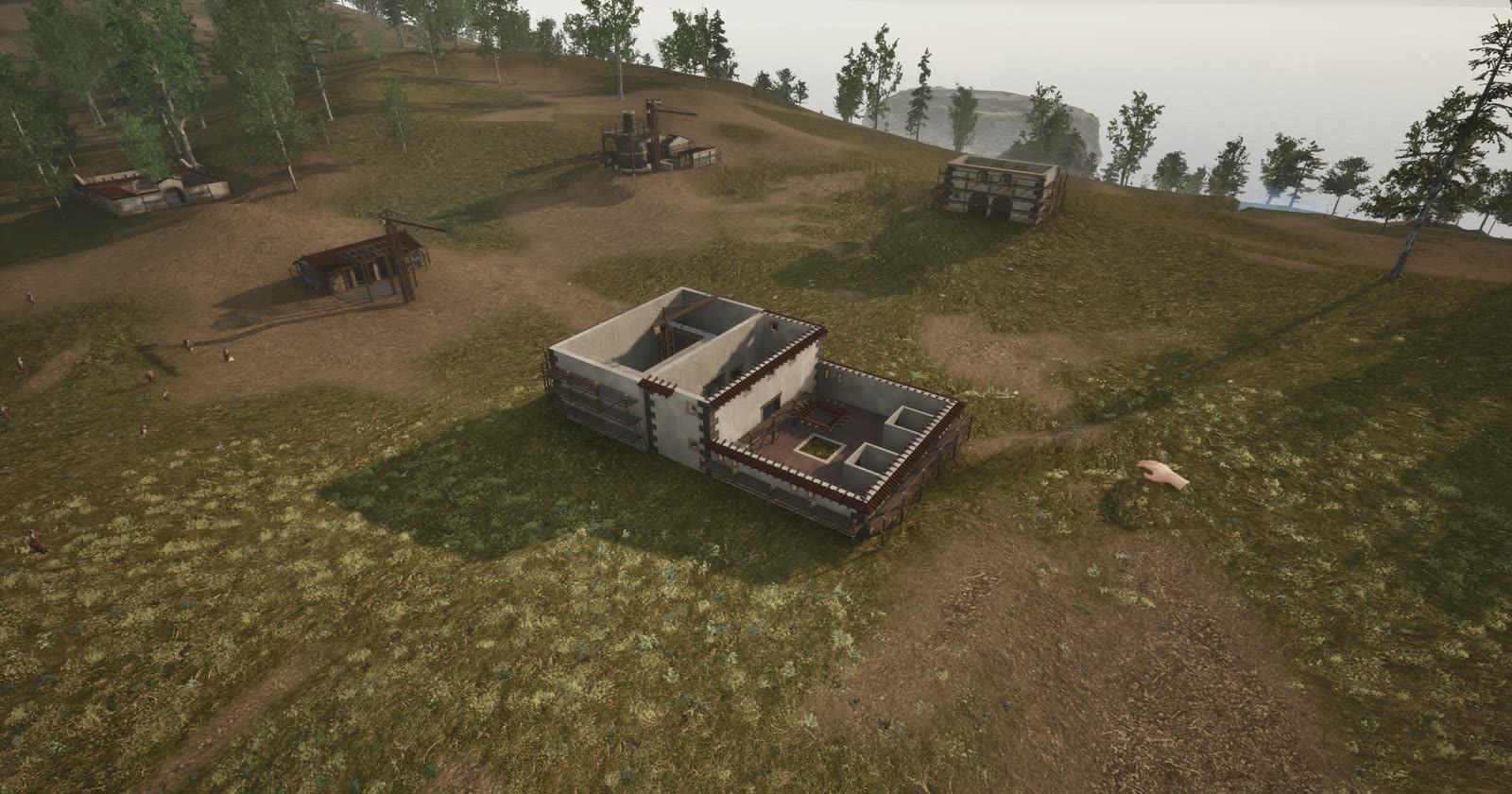
A building goes up in stages
Roman buildings reveal foundations, walls, floors, roofs and finishing pieces in a sequence set for each building. A site with no material delivered does not advance, and the panel on the site says what it is waiting for.
Scaffolding comes down near the end of construction. The timber for it comes out of the site's supplies and returns as a ground pile when the scaffold comes down. Builders claim a place to stand, climb to it, and add progress from there.
The build menu groups buildings into categories, families and variants. New cards unlock as the settlement grows and meets research or divine requirements.
Districts
Draw a rectangle and your villagers level the ground through an earthwork site. Mark what the district is for and new building sites fill its lots over time. The zone determines which buildings are placed, and your villagers build them as materials allow. Fences are placed separately.
A raised district can be built out from the floor of another, with a stair at the opening between them. This is how a settlement is built up a hillside.
Roads and paving
A road is drawn along the ground and the terrain underneath is graded to meet it, so the surface follows the landscape. Drag a freehand road or switch to orthogonal drawing. Roman streets use a separate grid of stone tiles.
Villagers walk a road in preference to open ground, so streets change the routes they take between work, home and storage.
Walls
The rampart tool draws walls and towers as one run, and the wall follows the ground it crosses. It places a tower at each end of a run and can join existing towers. Gate and Postern cards create walkable passages once builders finish them. Villagers route around a curtain wall. A maniple files through an open gate or postern in column and re-forms beyond it. Armies cannot breach the walls.
What the settlement produces
Timber comes from woodland, ore from the ground, grain from fields, and animals from pens. A lumber mill turns logs into planks and a smelter turns ore into metal; both need a crew working the machine, and both stop when there is too little room in their output stack.
The settlement sets its own targets for what to keep in store from what is being built, what needs repairing, how many households are occupied, and the army's upkeep. Those targets guide requests for gathering and workplace supplies.
What is not in it
Trade with neighbouring hamlets uses import and export rules on the town page; hamlets are still in testing. A rival god's town can found a market and stalls of its own; that market has not had a play session yet. The roadmap separates what is in the build from what is planned.